Showing posts with label history. Show all posts
Monday, 6 June 2011
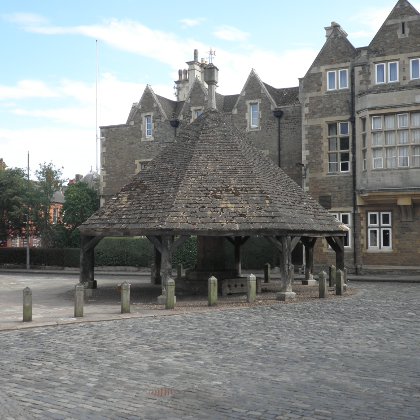
Oakham Buttercross & Stocks
A 17th century buttercross stands to the side of Oakham's market square. Originally locals would've gathered here to buy milk, eggs and butter.
Oakham's stocks are sheltered by the cross. Can you spot anything weird? :-)
Looking up into the roof of the buttercross...
Sunday, 24 April 2011
The Caldey Stone
The Caldey Stone dates for the 5th or 6th century and features two inscriptions, one in Latin, the other in Ogham. The Ogham is inscribed as a series of lines following the edge of the stone. Ogham was first used in Ireland before spreading across the Irish sea into Scotland, Wales and Cornwall.
Friday, 19 November 2010
The Grave of Charles MacArthur
"Here lies the remains of Charles Mackarter whose fame as an honest man and remarkable piper will survive this generation for his manners were easy & regular as his music and the the melody of his fingers will..."
Monday, 19 July 2010
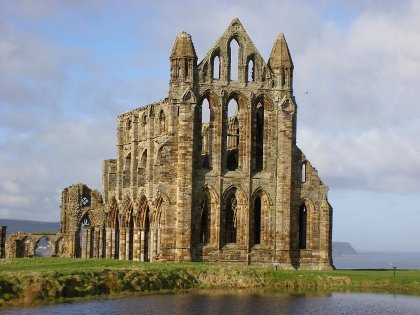
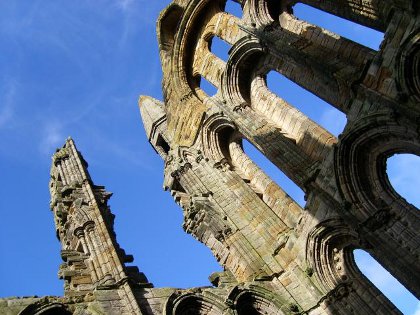
The Ruins of Whitby Abbey
Right over the town is the ruin of Whitby Abbey, which was sacked by the Danes, and which is the scene of part of "Marmion," where the girl was built up in the wall. It is a most noble ruin, of immense size, and full of beautiful and romantic bits. There is a legend that a white lady is seen in one of the windows.
Dracula - Bram Stoker
As the cloud passed I could see the ruins of the abbey coming into view, and as the edge of a narrow band of light as sharp as a sword-cut moved along, the church and churchyard became gradually visible. Whatever my expectation was, it was not disappointed, for there, on our favourite seat, the silver light of the moon struck a half-reclining figure, snowy white.
Dracula - Bram Stoker
Inspired by a visit to Whitby, I read Bram Stoker's Dracula closely followed by The Lair of the White Worm. It's easy to see how Stoker found inspiration in the crumbling ruins and the old town legends. :-)
Friday, 7 May 2010
Ruins on Stanton Moor
There are a few crumbling ruins scattered across Stanton Moor. The remains of this small square building have all but disappeared. :-(
Tuesday, 4 May 2010
The King Stone
The King Stone stands a few metres outside The Nine Ladies stone circle on Stanton Moor. Unfortunately the stone has been vandalised. The graffiti reads
Bill Stumps. :-( Modern Druids leave regular offerings at the centre of the circle. A pentacle and blood are the most recent.
Thursday, 8 April 2010
Arthur at Goonhilly
Arthur (Antenna One) is a satellite dish at the Goonhilly Satellite Earth Station in Cornwall. The dish measures 26m and relayed telephone calls and live TV from the Telstar satellite.
The site has a visitor centre with an exhibition of the history of satellite communications. Unfortunately the Goonhilly visitor centre closed last week until further notice. :-(
Wednesday, 7 April 2010
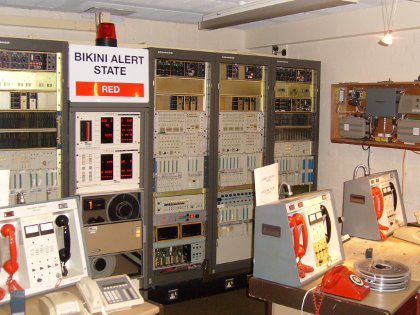
The Heart of the Bunker
Welcome to the control room at the heart of the Hack Green nuclear bunker. The threat level is at it's most serious,
Bikini Alert State Red- prepare for a hostile nuclear strike.
Saturday, 3 April 2010
Secret Nuclear Bunker
Let's hope the enemy can't read English, otherwise they'll have no problem finding the Hack Green secret nuclear bunker. Hack Green was intended to be the government headquarters in the event of war. :-(
Luckily the bunker is no longer in use. Hack Green was abandoned at the end of the Cold War and reopened as a museum in 1998.
Tuesday, 9 March 2010
The Church of Saint Lawrence
The church sits on the site of an Iron Age hill fort in the Chilterns, although it's difficult to spot any trace of the fort using Google maps. It's claimed the sphere on the tower was used as a secret meeting place by members of the Hellfire Club. Close to the church is the hexagonal Dashwood Mausoleum build by one of the Hellfire Club's founders, Sir Francis Dashwood.
Saturday, 6 March 2010
The Great Gatehouse at Hampton Court
The Great Gatehouse is the focal point of Hampton Court's west front. Originally the towers would have been topped with cupola. Hampton Court was built for Thomas Wolsey who later gave it as a gift to King Henry VIII.
Thursday, 4 March 2010
How Many Courtyards at Hampton Court?
Fountain Court was designed by Sir Christopher Wren and is one of the many courtyards at Hampton Court Palace. Sir Christopher is perhaps better known as the architect of Saint Paul's Cathedral.
How many courtyards are there at Hampton Court Palace? As I explored I kept discovering more until I eventually lost track! How many can you see on the aerial photo? After you've counted the courtyards can you find the famous maze?
Tuesday, 2 March 2010
The Astronomical Clock
The Astronomical Clock at Hampton Court Palace was made for Henry VIII in 1540 by the French clockmaker Nicholas Oursian. The clock shows the time of day, the date, the phase of the moon and the time of high tide at London Bridge.
Sunday, 28 February 2010
Oliver Cromwell, Lord Protector
Thornycroft's 1899 statue of Oliver Cromwell stands outside the Palace of Westminster in London. Cromwell served as a commander in the Parliamentarian army and was instrumental in the overthrow of the monarchy and the establishment of a republican commonwealth. He served as Lord Protector of England, Scotland and Ireland from 1653 until his death in 1658.
Friday, 26 February 2010
Richard I of England
Marochetti's heroic 1860 statue of Richard the Lionheart stands in the shadow of the Houses of Parliament. Richard reigned as king of England from 1189 until his death in 1199.
Thursday, 18 February 2010
Votive Offering to Mithras
The Temple of Mithras at Carrawburgh was discovered in 1949 and has it's origins in the 3rd century AD. The site was sacred to the Cult of Mithras. No evidence exists for the continuation of the cult after the 4th century, so who continues to leave a votive offering on the altar?
Monday, 8 February 2010
Cheddar Man in Gough's Cave
Cheddar Man is the name given to the oldest complete human skeleton discovered in the U.K., dated to 7150 BC. This replica is displayed in Gough's Cave where the remains were discovered in 1903. DNA testing has revealed descendants of Cheddar Man still live in Cheddar. A ceremonial staff made from reindeer antler, fox teeth and perforated shells were discovered with the remains.
References:
Thomas, N. A Guide to Prehistoric England London: Batsford, 1960.Sykes, B. The Seven Daughters of Eve London: Bantam Press, 2001.